


Meeting of the Board of Regents | March 2010
THE STATE EDUCATION DEPARTMENT / THE UNIVERSITY OF THE STATE OF NEW YORK / ALBANY, NY 12234
TO: Early Childhood Workgroup
FROM: John B. King, Jr.
SUBJECT: Early Childhood Education
DATE: March 1, 2010
STRATEGIC GOAL: Goal 1
AUTHORIZATION(S):
SUMMARY
Issue for Discussion
Two issue areas will be discussed at the March 2010 meeting:
- What guiding principles for reforming a comprehensive early childhood system are important for developing a theory of action?
- What strategic actions or policies are needed to strengthen the diverse early childhood service delivery system to assure that children are ready to learn?
Reasons for Consideration
The first area for discussion is focused on Guiding Principles. Principles that will be used to develop a Theory of Action need to be established. These principles and subsequent Theory of Action will be used as the basis for recommending comprehensive changes to the current early childhood service delivery system.
The second area of discussion is an exploration of the provider landscape for early care and education. The New York State early care and education system is immense. The emergence of a large scale statewide prekindergarten program became a bridge for change to the birth through age 3 service delivery sector and the kindergarten – grade 3 educational system. An analysis of what changes have occurred needs to be undertaken with discussions on policy implications.
Proposed Handling
The items will come before the Regents Early Childhood workgroup for discussion at the March 2010 meeting.
Research on Discussion Item
- Regents Policy on Early Education for Student Achievement in a Global Community (1996), http://www.regents.nysed.gov/meetings/2006Meetings/January2006/106emscvesida1.htm (Copies will also be available to the members of the Working Group at the March 2010 meeting.)
- New York State Early Childhood Data Report – New York State Council on Children and Families (Copies of this report will be provided to the members of the Working Group at the March 2010 meeting.)
- Covering the Pre-K Landscape: New Investments in Our Littlest Learners, a report from the Hechinger Institute on Education and the Media. (Copies of this report will be provided to the members of the Working Group at the March 2010 meeting).
- A Diverse System Delivers for Pre-K: Lessons Learned in New York State Pre[K]now, http://www.preknow.org//documents/diversedelivery_jul2006.pdf
Discussion Area #1 - Guiding Principles for Early Childhood in New York State
- Development: Supporting the development of young children requires parent involvement and the provision of comprehensive and integrated services through collaborative efforts.
- Full engagement of parents in the early education of their children is key to children’s success in the elementary classroom and later learning.
- Children placed at risk and their families must be supported through comprehensive services and early intervention.
- A cohesive early childhood delivery system must maximize collaboration and integration between very diverse providers of early childhood programs.
- Quality: An effective early childhood system requires high quality teachers, leaders, curriculum and instruction, and assessments.
- Early care and education must be focused on children’s learning and development. Children’s growth in language and social emotional development are fundamental to school readiness.
- Uniform and aligned early learning standards and assessments, at the appropriate level and rigor, must be used to strengthen the instructional core. Standards and assessments will be benchmarked to high performing states and nations.
- All teachers of young children must be certified and have access to ongoing professional development that is evidence based, linked to practice, and responsive to individual student needs.
- Effective leaders of early childhood programs must be instructional leaders in child development and early literacy.
- Access: Every child must have the opportunity to attend comprehensive, high quality early education programs, regardless of setting or community.
- Universal access to prekindergarten and full day kindergarten for all children placed at risk, English language learners and students with disabilities must be achieved.
- Easily accessed points of entry, with smooth transitions between agencies and programs, must be ensured.
- Accountability: NYS must ensure that the diverse system of providers delivers high quality programming.
- Benchmarking program effectiveness will be accomplished through the collection, tracking, and analysis of significant and uniform data.
- Transparency: Information on resource allocation, program quality ratings, and comprehensive data sets must be clear and usable for families and providers.
Discussion Questions on Guiding Principles:
Do the above guiding principles provide the framework for ongoing work?
Are additional principles needed for consistency with other SED initiatives?
Discussion Area #2 - Provider Landscape
New York has a long history of supporting early childhood care and education for our youngest learners, birth through age five. This system is rich in its scope, breadth, and volume. There are over 1.2 million children in New York State under the age of five. Approximately 500,000 of these children are in regulated care and 56,000 children in informal care. There are approximately 51,000 children in Head Start and Early Head Start serves approximately 5,700 children and expectant mothers. Over 67,000 preschool children with disabilities are in special education programs and services. There are 152 registered nursery schools serving children throughout New York State. In prekindergarten settings, there are over 102,000 children in eligible agencies.
The system is dynamic and changes frequently as new programs are added to the landscape. Volunteer literacy programs, parent education, home visiting, and health clinics are other types of initiatives that are constantly added to support young children and their families. But the system is fragmented. Our provider system is a collection of separate programs rather than an easily navigated, transparent and cohesive system. Governance structures fall under multiple state agencies, with additional complexity at the county and district level.
The diversity of the delivery system is both a strength and a challenge. In New York, closing access and achievement gaps for all children is of the highest priority. Early care and early childhood education have an important role to play in ensuring that children are learning in every early childhood setting and that each setting is high quality.
The emergence of the statewide prekindergarten program provided one of the first opportunities for systemic collaboration. Two key components of this legislation began to reshape early care and education in New York:
- Funding went directly to school districts; and
- Districts were required to use a specific percentage of funds to collaborate with community based organizations.
This legislation was a clear signal that the State’s prekindergarten initiatives would focus on learning, using common standards, highly qualified teachers and excellent instruction in all settings, including child care, Head Start, nursery schools, special education preschools, etc.
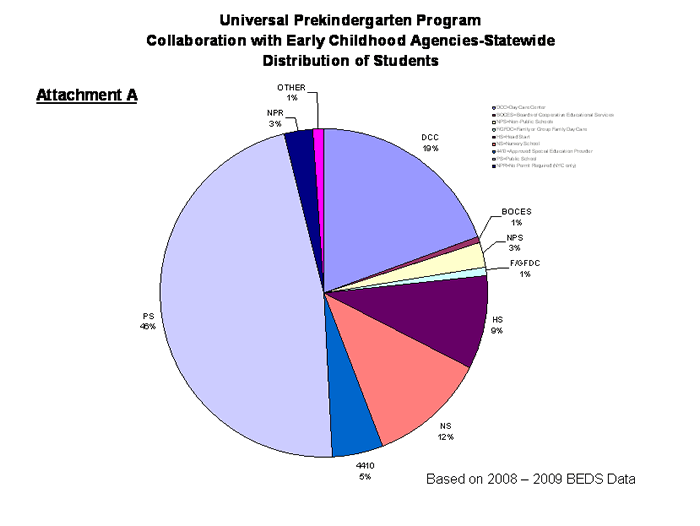
The intent of the legislation has been achieved in large part. Since legislation passed in 1997, 40% - 60% of funding has been used for collaborations with community based settings (see Attachment A). The required collaborations have impacted how services are delivered and instruction is provided.
The following are several areas impacted by the statewide prekindergarten program:
- Professional development was conducted for teachers and administrators through shared initiatives.
- Many districts required that CBOs use the same curriculum used in the public schools.
- Districts monitored and evaluated the settings in CBOs.
- CBOs were often provided with classroom materials and supplies and a wider variety of support services.
- Assessments and program monitoring across settings began to occur.
- Prekindergarten began to be viewed as a new starting point for school which also underscored the need for full day kindergarten.
- In regions where there have been a high number of districts implementing UPK, early childhood career ladders were expanded and training towards advanced levels of certification and education occurred.
- The need for full implementation of prekindergarten to provide a base for integrating children with disabilities was highlighted.
- Transitions were strengthened between prekindergarten and kindergarten.
Discussion Questions:
What components of this diverse system need strengthening?
What areas of transition are most in need of improvement?
What components have been most effective for ensuring school readiness?
Next Steps
- National Governors Association Proposal
- Development of Theory of Action
- Conduct Statewide Regional Meetings