



Meeting of the Board of Regents | July 2009
|
|
THE STATE EDUCATION DEPARTMENT / THE UNIVERSITY OF THE STATE OF NEW YORK / ALBANY, NY 12234 |

|
TO: |
The Honorable the Members of the Board of Regents |
|
FROM: |
Rebecca H. Cort
|
|
SUBJECT: |
Implementation Plan for the Recommendations from the Regents Project Management Group
|
|
DATE: |
July 9, 2009 |
SUMMARY
Issue for Discussion
The Regents will review and comment on: (1) the proposed timeline and deliverables for the work of the PMO Core Team and its subgroups; and (2) the draft framework for the district-based approach to school improvement, providing guidance on the policy questions and challenges identified by the PMO School Improvement Team.
Reason for Consideration
At the May meeting, the Board reviewed and approved the recommendations of the Regents Project Management Group (PMO Group) as a first step in developing a Statewide plan for school improvement and transforming SED into a high-performing service organization. Based on the Board’s action, the PMO Core Team was charged with developing specific proposals to implement those recommendations and presenting them to the Regents for review and consultation.
Background Information
The Board of Regents sought and secured foundation support to build capacity to raise student achievement through three integrated strategies: research-based practice, a P-16 data system to guide that practice, and a transformed State Education Department as the organizational platform. The foundation support enabled the Regents to engage consultants to assist with this work. Since December 2008, the Regents PMO Group has considered several questions raised by the consultants’ draft recommendations for increasing SED’s capacity to drive school improvement and student achievement, including: (1) whether SED should adopt a district-based approach to school improvement; (2) what field structures the Regents should adopt to best implement a district-based approach; and (3) how to structure SED’s internal organization to best pursue the Regents’ expected outcomes of increasing student performance and closing the achievement gap and to ensure that SED staff have opportunities to grow within an integrated structure.
Recommendation
That the Regents affirm the PMO Core Team’s work to date and provide guidance to facilitate its ongoing development of plans to implement the Board’s recommendations.
Timetable for Implementation
Upon the Board’s approval of the proposed timeline and deliverables and guidance regarding the draft framework, the development of detailed implementation plans will continue for subsequent review.
Attachments
Introduction
At the May 2009 Regents Meeting, the Board reviewed a report from the Regents PMO Group and affirmed its recommendations to:
- Design a cohesive, district-based approach to school improvement, addressing SED’s internal organization and field structure (including NYC and the Big 4) and
- Redesign the internal structure of the Department to realign responsibilities within P-12, Special Education and Higher Education including integrating special education and general education and consolidating certain responsibilities of the NYC office into SED’s statewide structure.
As a result, Commissioner Mills formed a PMO Core Team headed by Deputy Commissioner Rebecca Cort. The purpose of this group is to develop specific proposals to implement these recommendations. A larger group has also been formed to focus specifically on the design of the school improvement network and additional groups will be named as we prepare to address the Department redesign issues.
The attached chart reflects the proposed timeline for the work of the PMO Core Team and its subgroups. (See Attachment A.) As indicated, groups would complete their work and the recommendations would be implemented by July 2010. We seek your guidance on the proposed timelines and deliverables.
The current discussions have resulted in a draft framework for the district-based approach to school improvement that is described below. The Team has also identified several policy questions and challenges on which further guidance is needed as we move forward within a demanding timeframe.
School Improvement Technical Assistance Networks:
- Guiding Principles
As directed by the Regents, the PMO School Improvement Team (“Team”) has begun designing a framework for a new network to provide critical school improvement supports and interventions to districts to ensure their capacity to improve student performance within their schools. Based on the Regents recommendations, the Team has identified the following principles to guide the development of the new regional network structure:
- Capacity-building: SED’s main school improvement focus will be on school districts, i.e., SED will help districts build sustainable capacity to improve their schools.
- Instructional Core: School improvement efforts at all levels (Regents, SED, districts, schools) will target the instructional core – the interaction between teacher, student and curriculum – and will focus on a limited number of key, research-based practices determined to have the greatest effect on improving student results.
- All Students: While the primary focus of SED’s school improvement system will be on those districts that have been identified as needing improvement by our accountability measures, SED must also work to improve our capacity to provide resources and supports for all districts and their students.
- Accessibility: Support and assistance must be readily available to districts, provided by individuals with expertise in instructional methodology and specific content areas, and based on an assessment of the district’s instructional programs and practices.
- Consistency: District-based supports and interventions will be applied consistently statewide and based on SED-approved, standard protocols.
- Accountability: The network system will be accountable to SED for the efficient deployment of relevant resources serving identified districts, consistent and high-quality application of required quality indicator protocols, and regular evaluation and reporting of improved district results. School districts will be accountable to SED for improving student achievement. SED will also be responsible for regularly monitoring and evaluating the system to determine its effectiveness in improving district results and for making adjustments to the system to ensure continued effectiveness.
- Authority: SED will use its full authority to direct districts to utilize specific interventions and services based on their needs.
B. Framework for Regional Structure
The Team proposes a two-phase approach to redesigning the school improvement system based on several considerations:
- The Regents recommendation to integrate both special education and general education Department operations within P-12 as it develops its school improvement technical assistance systems;
- Current funding and resource possibilities and limitations;
- The anticipated reauthorization of NCLB/ESEA;
- The July 1, 2009 start up of VESID’s new “Regional Special Education Technical Assistance Support Centers” (RSE-TASC); and
- The June 30, 2010 expiration of several current general education technical assistance center contracts.
Phase One:
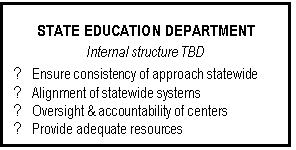
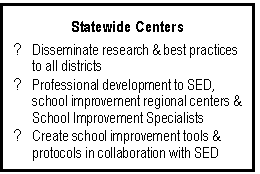
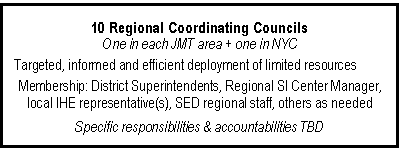
Using the guiding principles listed above, the Team has begun to design a system that aligns with the new VESID RSE-TASC structure. The attached chart reflects the draft integrated design of this system which is built around 10 Regional School Improvement Centers – one for each of the nine BOCES Joint Management Team (JMT) areas and one for New York City. (See Attachment B.) In addition, several topic specific Statewide Technical Assistance Centers (e.g., Response to Intervention (RtI), English Language Learners, Career and Technical Education, Network Professional Development (PD) Center, Transition Services, Positive Behavioral Supports and Interventions (PBIS)) would be or have been created to disseminate research and best practices to all districts, work with SED to create school improvement tools and protocols, and provide intensive professional development to regional and local school improvement specialists within the new network. VESID has targeted use of IDEA funds for the RtI, PBIS, Transition Service and Network PD Centers.
The Team anticipates that the new general education school improvement system will be operational by July 2010, with an RFP issued to the field on or about September 2009 to establish an interim general education companion system to the VESID RSE-TASCs. The two networks would be designed to function in a coordinated and collaborative manner, in philosophy and approach. During this time period, SED will complete its internal reorganization based on the Regents recommendations, which will include integrating special education and general education and the development of P-12 and Higher Education program areas. In addition, the Department will need to assess the effectiveness and continued relevance of this approach. Anticipated changes to federal accountability requirements driven by No Child Left Behind (NCLB) and the Individuals with Disabilities Education Act (IDEA) as well as the impact of possible Race to the Top funding for school improvement efforts will be major considerations in any evaluation of the State’s regional framework.
Phase Two:
After two years of operation, the Team recommends an assessment of the school improvement technical assistance structure using available outcome data as well as surveys and/or focus groups of stakeholders and participants. The evaluation should focus on the system’s success in impacting school district performance. Based on such evaluation and consideration of the timing and extent of expected revisions to NCLB, SED will consult with the Board to decide whether to retain the school improvement technical assistance structure described above or move to another design. Funding and Department staff capacity will also play a critical role in determining possible future internal and external structures. Based on this review, the Team proposes that a new RFP would be issued in 2013 for single network, consolidating the special education and general education technical assistance systems.
- Policy Questions and Challenges Faced
- Funding: Funding and resources are a major issue on which Regents guidance is needed. Currently, the Department projects the availability of approximately $4,500,000 in Title IIA general education funding and a portion of $7,500,000 in State Local Aid Bilingual Funds that might be able to be allocated to the Regional and Statewide Centers, while understanding that these funds have mandates regarding the populations to be served and the types of allowable services. At the same time, we estimate a required base of approximately $40,000,000 of general education resources to appropriately staff and maintain the needed expertise and capacity within the ten Regional Centers and several statewide centers. A related and significant barrier is the statutory restriction on the Department’s ability to retain more than a very small percentage of the NCLB Section 1003(a) and (g) school improvement monies. The Department leadership has already expressed interest in advocating for revisions to NCLB to allow a State to use a larger percentage of Title I funds for discretionary purposes, consistent with the IDEA funding requirements, so that SED would have the resources necessary to build a comprehensive school improvement system. However, this will take some time. We are exploring ways to access other possible sources of federal or state dollars and seek your guidance on how to prioritize our efforts if additional funds are not made available.
Question: Are there ways in which the Regents and SED can access other sources of federal or State dollars to appropriately fund the school improvement network? If additional funds are not available, how should SED prioritize its school improvement efforts?
- Focus areas: A major factor in the success of the special education networks has been the focus on a very limited number of professional development areas, i.e., literacy, behavior, special education instruction. Given the anticipated resources and the essential nature of a high level of expertise in any focus areas that are incorporated into the RFP, we are seeking guidance on the range of general education areas that should be included. Areas to be considered include Literacy, English Language Learners, Mathematics, Specially-designed Instruction, Leadership, and Career and Technical Education.
Question: What should be the focus of the Regional Centers and what topic areas should have priority?
- Assessment vs. Intervention: The Regents PMO Group recommended that the Team consider the use of external review teams for assessing certain districts and schools identified as in need of improvement. It was also recommended that the process of external reviews be totally separate from the intervention process. The Team has reviewed the literature and other states’ procedures. This has led us to believe that a structure reliant on external review teams would be prohibitively expensive and a substantial administrative burden requiring greatly increased Department staff resources, and it would not guarantee consistent and high quality identification of needed interventions that are reflected in the principles outlined above. The Team also believes that a carefully constructed RFP will ensure that the entities selected to run the school improvement networks can provide objective, unbiased reviews of districts’ needs based on strong, research-based protocols developed in conjunction with SED staff. The Team seeks your guidance on developing a structure that would not exclude the school improvement networks from having a role in the assessment and intervention planning process.
Question: Is it acceptable for SED to develop a school improvement structure in which the networks play a role in the assessment and intervention planning process?
- Independent Statewide Centers: The Team has studied how to unify the many existing technical assistance structures currently funded by the Department. It has concluded that there are a number of centers with very narrow areas of focus that would not be appropriate to integrate into the proposed school improvement system. For example, centers focused on such topics as school safety, after-school programs, adult education, and school health services have very specific mandated service delivery requirements and are not generally connected to the accountability systems. Given the possible loss of categorical funding and of unique statewide capacity if significant changes were proposed, the Team seeks feedback on our recommendation that certain centers remain independent entities that may have some interaction but would primarily exist apart from the Regional Center network.
Question: Should SED retain some separate centers that would serve unique functions based on funding and regulatory restrictions?
- Accountability systems: A major challenge is the alignment of the school improvement system with both federal and State accountability systems and requirements. Certain aspects of SED’s differentiated accountability plan, which was recently approved by USDE, may limit our options as we try to simplify the types of interventions for identified districts and schools. This is further complicated by the complex requirements within Chapter 57. We seek your guidance on whether we should amend Chapter 57 to enable SED to further streamline its accountability system.
Question: Should the Regents and SED seek amendments to Chapter 57 to streamline the types of interventions for identified districts and schools and revise its differentiated accountability plan?
|
PMO IMPLEMENTATION |
Lead: |
Attachment A Rebecca Cort |
|||||||||||||||||||||||||||||||||||||
|
Team: |
(Core) |
J. Duncan-Poitier A. Bianchi |
J. Burman G. Bowden |
D. Cunningham J. DeLorenzo |
M. Drzonsc J. Guilz |
R. Kennard R. Reyes |
|
||||||||||||||||||||||||||||||||
|
|
(School Improve) |
J. Bumbalo |
J. Delaney |
P. Geary |
P. Thompson |
+ Core Team |
|||||||||||||||||||||||||||||||||
|
|
|
|
2009 |
2010 |
|||||||||||||||||||||||||||||||||||
|
TASK |
Start |
End |
May |
June |
July |
Aug |
Sept |
Oct |
Nov |
Dec |
Jan |
Feb |
March |
April |
May |
June |
July |
||||||||||||||||||||||
|
05/28/09 |
07/28/09 |
|
|
|
|
|
|
|
|
|
|
|
|
|
|
|
|
|
|
|
|
|
|
|
|
|
|
|
|
|
|
|||||||
Draft timeline |
05/28/09 |
06/30/09 |
|
|
|
|
|
|
|
|
|
|
|
|
|
|
|
|
|
|
|
|
|
|
|
|
|
|
|
|
|
|
|||||||
Regents approve timeline |
07/28/09 |
07/28/09 |
|
|
|
|
|
|
|
|
|
|
|
|
|
|
|
|
|
|
|
|
|
|
|
|
|
|
|
|
|
|
|||||||
|
05/28/09 |
06/30/11 |
|
|
|
|
|
|
|
|
|
|
|
|
|
|
|
|
|
|
|
|
|
|
|
|
|
|
|
|
|
|
|||||||
Draft framework |
05/28/09 |
07/09/09 |
|
|
|
|
|
|
|
|
|
|
|
|
|
|
|
|
|
|
|
|
|
|
|
|
|
|
|
|
|
|
|||||||
Regents affirm direction |
07/28/09 |
07/28/09 |
|
|
|
|
|
|
|
|
|
|
|
|
|
|
|
|
|
|
|
|
|
|
|
|
|
|
|
|
|
|
|||||||
Regional networks RFP developed |
08/15/09 |
10/14/09 |
|
|
|
|
|
|
|
|
|
|
|
|
|
|
|
|
|
|
|
|
|
|
|
|
|
|
|
|
|
|
|||||||
Regents affirm detailed approach/further direction |
10/17/09 |
10/17/09 |
|
|
|
|
|
|
|
|
|
|
|
|
|
|
|
|
|
|
|
|
|
|
|
|
|
|
|
|
|
|
|||||||
Regional networks RFP issued/Bidders conference |
10/15/09 |
10/30/09 |
|
|
|
|
|
|
|
|
|
|
|
|
|
|
|
|
|
|
|
|
|
|
|
|
|
|
|
|
|
|
|||||||
Regional networks RFP applications due |
10/15/09 |
12/10/09 |
|
|
|
|
|
|
|
|
|
|
|
|
|
|
|
|
|
|
|
|
|
|
|
|
|
|
|
|
|
|
|||||||
RFP applications evaluated & awards made |
12/10/09 |
02/01/10 |
|
|
|
|
|
|
|
|
|
|
|
|
|
|
|
|
|
|
|
|
|
|
|
|
|
|
|
|
|
|
|||||||
Regional network center contracts finalized |
02/02/10 |
06/30/10 |
|
|
|
|
|
|
|
|
|
|
|
|
|
|
|
|
|
|
|
|
|
|
|
|
|
|
|
|
|
|
|||||||
Regional network centers start date |
07/01/10 |
07/01/10 |
|
|
|
|
|
|
|
|
|
|
|
|
|
|
|
|
|
|
|
|
|
|
|
|
|
|
|
|
|
|
|||||||
Professional development design & preparation |
01/01/10 |
04/15/10 |
|
|
|
|
|
|
|
|
|
|
|
|
|
|
|
|
|
|
|
|
|
|
|
|
|
|
|
|
|
|
|||||||
Deliver professional development to regional staff |
07/01/10 |
06/30/11 |
|
|
|
|
|
|
|
|
|
|
|
|
|
|
|
|
|
|
|
|
|
|
|
|
|
|
|
|
|
|
|||||||
Implementation of new approach |
07/01/10 |
|
|
|
|
|
|
|
|
|
|
|
|
|
|
|
|
|
|
|
|
|
|
|
|
|
|
|
|
|
|
|
|||||||
Evaluation of new approach |
06/30/12 |
|
|
|
|
|
|
|
|
|
|
|
|
|
|
|
|
|
|
|
|
|
|
|
|
|
|
|
|
|
|
|
|||||||


Attachment B
Overview: School Improvement Statewide System








|
10 Regional School Improvement Centers One in each JMT area + one in NYC |
|||
|
AREAS OF FOCUS (for both Special Education and General Education Students) |
|||
|
Literacy Numeracy |
Career & Technical Education Dual Language Acquisition |
Behavior/Readiness to Learn Instructional Practices |
Transition |
|
THE WORK |
|||
|
TBD; possible examples: Development & use of common tools & protocols; professional development; coaching, assisting in implementation of best practices, etc. |
|||
|
STAFFING |
|||
|
|||
 Regional Special Education and General Education Experts in selected areas of focus who work with all designated districts
|
|
|
|
||||
|
|
Identified Low-performing Districts |
|
Identified Low-performing Districts |
|
Identified Low-performing Districts |
|
|
|
||||||