



Meeting of the Board of Regents | January 2009
|
|
THE STATE EDUCATION DEPARTMENT / THE UNIVERSITY OF THE STATE OF NEW YORK / ALBANY, NY 12234 |

|
TO: |
VESID Committee
|
|
FROM: |
Rebecca H. Cort
|
|
SUBJECT: |
Dispute Resolution in Special Education – A Review and Analysis of New York State Due Process System
|
|
DATE:
|
December 23, 2008 |
|
STRATEGIC GOAL:
|
Goals 1 and 2 |
|
AUTHORIZATION(S):
|
|
Summary
Issue for Discussion
New York State’s (NYS) special education due process system for students with disabilities.
Reason for Consideration
Information
Proposed Handling
This item will be discussed with the Committee at its January 2009 meeting.
Section 615(b)(5) of the Individuals with Disabilities Education Act (IDEA) requires states to establish and maintain procedures to ensure that children with disabilities and their parents are guaranteed procedural safeguards with respect to the provision of a free appropriate public education. As part of these procedures, each state must:
- ensure that parents are informed of their procedural safeguards;
- establish a mediation process to resolve disputes between parents and school personnel;
- establish an impartial due process hearing process; and
- establish and implement a State complaint process.
- Procedural Safeguards Notice
Section 200.5(f) of the Regulations of the Commissioner of Education requires that school districts provide a parent a copy of the Procedural Safeguards Notice at least once per year, and other instances as required by federal law. NYS requires school districts to use the State developed Procedural Safeguards Notice as prescribed by the Commissioner of Education . This Notice is a comprehensive document which describes the parents’ rights as they pertain to the special education process.
- Special Education Mediation
Section 4404-a of the Education Law and section 200.5(h) of the Regulations of the Commissioner of Education describe the State’s system of special education mediation. Section 200.1(dd) establishes the qualifications of a Mediator. Mediation must be available to school districts and parents to resolve disputes involving any matter for which an impartial due process hearing may be brought. Mediation is also available to the parties in NYS to resolve disputes prior to a request for an impartial hearing. Mediation is at no cost to the parties and the State bears the cost of special education mediation through its federal IDEA funds. Special education mediation is a voluntary process in which parent(s) of a child with a disability and the school district meet with a mediator to reach a mutual agreement. The written agreement reached through mediation is binding on the parties and is enforceable in court. In NYS, mediation is conducted by community dispute resolution centers .
- Impartial Due Process Hearings
Section 4404 of the Education Law and sections 200.5(j) of the Regulations of the Commissioner of Education establish the State’s impartial due process hearing system. An impartial hearing is a proceeding at which an impartial hearing officer (IHO) makes a decision based on evidence and testimony provided by both parties. The decision of an IHO is legally binding upon the parties.
Section 200.1(x) establishes the qualifications of an IHO. In NYS an IHO must be an individual who is an attorney and who has a minimum of two years practice and/or experience in the areas of education, special education, disability rights or civil rights; or an individual who was a certified IHO on September 1, 2001. Section 200.21 of the Regulations of the Commissioner of Education establishes the IHO rates and procedures for suspension or revocation of certification of an IHO.
Section 200.5(j)(2) establishes the process for resolution meetings. A resolution session, which includes the parents and the relevant member(s) of the Committee on Special Education (CSE), is a meeting at which the parents of the student discuss their complaint and the school district has the opportunity to resolve the complaint prior to initiation of the impartial hearing.
In New York State, the decision of an IHO may be appealed to the State Review Officer (SRO). Part 279 of the Regulations of the Commissioner of Education establishes the procedures for appeals to the SRO. The written decision of the SRO is final, provided that any party may seek judicial relief in accordance with Civil Practice Law and Rules or 20 USC section 1415.
- State Complaint Procedures
Section 200.5(l) of the Regulations of the Commissioner of Education establishes the State complaint process. The State complaint process is available to any organization or individual that alleges that a violation of law or regulation has occurred. The State must conduct an investigation of an alleged violation of a federal or State law or regulation relating to special education and issue its findings within 60 calendar days of receipt of the State complaint.
Background Information
Attachment 1 provides a chart describing special education mediation, impartial hearings and the State complaint procedures for resolving special education disputes and complaints. The following provides data on the use of these procedures in NYS and actions to implement and improve on these systems.
Special Education Mediation:
In 2007-08:
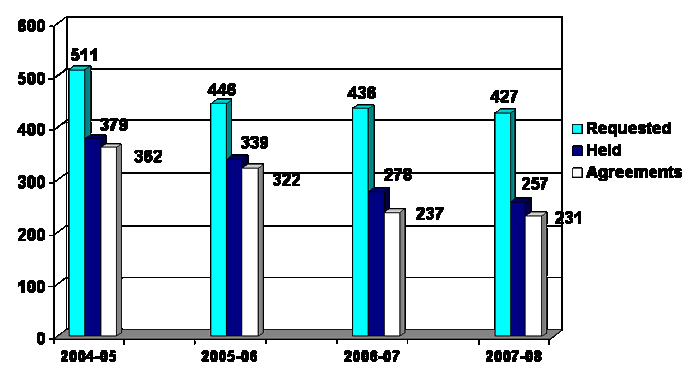
- 427 requests for mediation were received
- 247 mediation sessions were held
- 231 mediation sessions resulted in mediation agreements.
Attachment 2 provides four-year trend data on the use of mediation in NYS. This data demonstrates that mediation sessions, which are at no cost to school districts and parents, are underutilized as a dispute mechanism in this State, especially when compared to the high number of requests for impartial hearings. The four-year trend data shows that the use of mediation has steadily declined. One reason for the decline in the use of mediation may be correlated to the introduction of resolution sessions prior to impartial hearings as a means of resolving disputes. When mediation sessions are used, approximately 93 percent result in agreements between the parties to settle the dispute.
The following actions have been taken to increase the use of mediation in NYS.
- SED contracts with the New York State Dispute Resolution Association (NYSDRA) to oversee the special education mediation process. In NYS, independent volunteer mediators furnished by a Community Dispute Resolution Center through the Office of Court Administration conduct mediation sessions. SED and NYSDRA jointly develop training programs, which NYSDRA provides to the mediators. Under a new contract, the vendor will be expected to provide greater outreach to parents and school personnel to promote the use of mediation in this State.
- Staff from the New York City (NYC) Special Education Quality Assurance (SEQA) Regional Office participate in a workgroup comprised of representatives from the NYC mediation centers, NYC Department of Education (DOE), NYSDRA and the advocacy community. The group is developing a standard of guidelines for special education mediation in NYC, including ways to increase the use of mediation to resolve disputes.
Impartial Hearings:
Impartial hearings are requested to resolve disputes regarding a number of matters, including requests for tuition reimbursement for unilateral parental placements and other services; and disputes regarding students' disability classification, evaluations, including independent evaluations; individualized education program (IEP) recommendations and placement; transportation; and disciplinary issues.
The following data describes the use of impartial hearings to resolve special education disputes in 2007-08 as reported as of June 30:
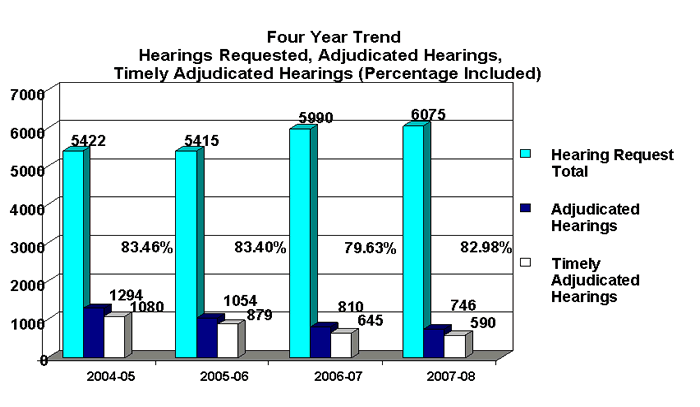
- 6,075 requests for impartial due process hearings were submitted.
-
- 90 percent of these hearing requests came from NYC
- 4 percent came from Hudson Valley
- 3 percent came from Long Island
- The remainder came from the other upstate regions of the State.
- Of the 6,075 requests, 5,329 were withdrawn and/or resolved through mediation or settlement agreements.
- 746 impartial hearings were conducted that resulted in adjudicated decisions.
-
- 93 percent of the hearing decisions came from NYC.
- Of the 746 hearings, 590 were completed within the State required timelines or extended timelines.
- In 2007, 140 impartial hearing decisions were appealed to the SRO.
Attachment 3 provides information on the four-year trend on the use of impartial hearings in NYS. The data shows that the use of impartial hearing requests to resolve disputes has increased over the past three years (from 5,422 in 2004-05 to 6,075 in 2007-08). However, the number of adjudicated hearings decreased from 1,294 in 2004-05 to 746 in 2007-08. There has been an upward trend over the past three years of impartial hearings requested for tuition reimbursement (from 12.55 percent of the hearing requests in 2004-05 to 25.61 percent of the hearing requests in 2007-08 - all but 11 of which came from NYC). This may be correlated with the change in the statute of limitations for requesting an impartial hearing from one year to two years. There has also been an upward trend over the past three years in disputes regarding the student's disability classification.
The following actions have been taken to improve the State’s impartial hearing process.
- SED maintains an electronic Impartial Hearing Reporting System (IHRS) to monitor the timeliness of IHO decisions.
- Data collected through IHRS has been used to provide IHOs with an activity summary of the total number of cases to which they were appointed and whether those cases were addressed in a timely manner. Trend information is also provided.
- IHOs receive an IHO Performance Summary which allows the IHO to see his/her timeliness performance for the time period selected.
- Based on NYS regulations, SED initiated 31 investigations in impartial hearing cases where the decisions appeared overdue. When a complaint was founded, IHOs were required to participate in additional training. In 2008, two NYC IHOs were required to participate in individual tutorials regarding timelines. VESID revoked the certification of one NYC IHO as a result of founded complaints regarding timelines.
- Beginning in 2008-09, VESID will institute a noncompliance notification process for IHOs who have an overdue decision. The notifications will be monitored and data from the notification process will be used in future IHO investigations.
- SED provided all NYC IHOs with a two-day training session in April 2008. Eighty-two (82) IHOs and two administrators from the NYC IHO office attended this training, which included a session on procedures to ensure timely decisions. In March 2008, 34 upstate IHOs, 12 SED Counsel and 15 SROs attended similar training. These training sessions also introduced an extension calculation tool available to IHOs through the IHRS.
- A website for IHOs was established in February of 2007, which includes posting of alerts, access to applicable laws and regulations, SRO information, Commissioner of Education decisions, IHRS information, and links to the VESID publications page. Timely access to such information assists IHOs to access and review relevant information necessary to reach a timely decision in a case.
- VESID has entered into a Memorandum of Understanding with the University of Buffalo Law School to develop a Procedural Guide for use by all IHOs to ensure consistency in due process hearings, which is scheduled for completion in June 2009.
- Beginning in 2009-10, VESID will be requiring IHOs to attend annual training updates.
- NYCDOE has appointed impartial hearing liaisons in each of the five Integrated Service Centers to oversee the implementation of IHO’s decisions.
State Complaints:
The following data describes the use of the State complaint process in 2007-08:
- 380 State complaints were received.
- 321 State complaint findings were issued, of which 219 included findings of noncompliance with federal and/or State law or regulations.
- The remainder of the State complaints were either withdrawn by the complainants, set aside because the issues were being addressed through an impartial hearing or dismissed due to VESID's lack of jurisdiction over the matters in dispute.
The following actions have been taken to improve the State complaint process.
- NYC SEQA staff conducts regularly scheduled meetings with central office special education administrative and supervisory staff of NYCDOE and the Deputy Executive Directors of Special Education of the Regional Integrated Service Centers to review and address systemic issues and individual State complaints.
- NYC SEQA staff and professional development specialists from the VESID funded Special Education Training and Resource Center (SETRC) in NYC provide technical assistance and professional development to districts/school personnel on systemic State complaint issues.
- All VESID SEQA and policy staff participated in training on State complaint investigations in the fall of 2008.
Attachment 4 provides four-year trend data on the use of State complaints in NYS.
Next Steps:
In addition to the above noted activities, VESID is taking additional steps to improve the quality of dispute resolution, reduce the numbers of impartial hearings, and promote better communication and cooperation between parents and school districts:
- Effective January 1, 2009, the VESID Special Education Office has expanded the number of Special Education Parent Centers across NYS to 11 (Mid-west, Mid-state, north country, capital district, southern, Hudson Valley, Bronx, Brooklyn, Manhattan, Queens and Staten Island). These new centers are in addition to Special Education Parent Centers currently funded in Long Island and Western New York. Mandatory deliverables of the Parent Centers include providing parents of children with disabilities information and approaches to promote early resolution of disputes between parents and school districts on special education mediation, due process and the State complaint process.
- Through a new contract with SED, NYSDRA will conduct regional professional development sessions regarding alternative dispute resolution for professionals and parents such as conflict resolution processes, parent-to-parent assistance, IEP facilitation, early complaint resolution and mediation. These sessions will be conducted in collaboration with the VESID-funded Parent Centers and Regional Special Education Trainers.
- Beginning in 2009, comprehensive training sessions for CSE and Committee on Preschool Special Education (CPSE) Chairpersons will be conducted throughout the State.
- The State-mandated IEP forms and notices, when implemented, are expected to lead to better IEPs for students with disabilities and parents more fully informed of recommendations for their children.
Attachments
Methods for Resolving Special Education Disputes in New York State
|
Method for Resolving Disputes |
Description of Method |
Persons Involved |
|---|---|---|
|
MEDIATION
|
Dispute resolution between parents and a school district for any matter prior to the filing of a due process complaint. Mediation is voluntary on the part of both parties involved and free of charge to both parties as the State pays the costs. Mediation may result in a binding written agreement enforceable in any State court of competent jurisdiction or in a district court of the United States. While there is no appeal process involved in mediation, a party may initiate a due process complaint requesting an impartial hearing at any time during or after the mediation process, and may include matters arising prior to the filing of the due process complaint notice. |
A qualified and impartial individual trained in effective techniques and knowledgeable in laws and regulations relating to the provision of special education services, selected by a community dispute resolution center on a random or mutual agreement basis. The mediator may not be an employee of the State Education Department (SED) or the school involved in the education or care of the child and must not have a personal or professional interest which conflicts with the mediator’s objectivity.
|
|
IMPARTIAL DUE PROCESS HEARING |
Dispute resolution, more formal than mediation, regarding any matter relating to the identification, evaluation or educational placement or provision of a free appropriate public education.
|
The IHO is appointed by a district’s board of education through a rotational selection process. An IHO must be certified by the Commissioner of Education by having successfully completed a training program, conducted by SED, which program provides information regarding State and federal laws and regulations relating to the education of students with disabilities, the needs of such students, and the procedures involved in conducting a hearing, and in reaching and writing a decision; and attend such periodic update programs as may be scheduled by the commissioner. IHOs must possess knowledge of, and the ability to understand, the provisions of federal and State law and regulations pertaining to the Individuals with Disabilities Education Act (IDEA) and legal interpretations of such law and regulations by federal and State courts; and possess knowledge of, and the ability to conduct hearings in accordance with appropriate, standard legal practice and to render and write decisions in accordance with appropriate standard legal practice.
|
|
FORMAL STATE COMPLAINTS |
Any individual or organization may file a State complaint alleging a violation of any Part B requirement by a school district, SED, or any other public agency. A State complaint must be resolved within a 60-calendar-day timeline, unless that timeline is extended, and involves an investigation of allegations made, if necessary. The district or other public agency is provided with the opportunity to respond to the complaint. A written decision is issued. This written decision is final; there is no appeal process for a State complaint, except when the State complaint is filed relating to the child find or consultation process for parentally placed nonpublic school students with disabilities. |
SED staff: Special Education Quality Assurance (SEQA) regional office staff. |
Four Year Trend
Special Education Mediation
Four Year Trend
State Complaints Received,
Complaints with Findings of Noncompliance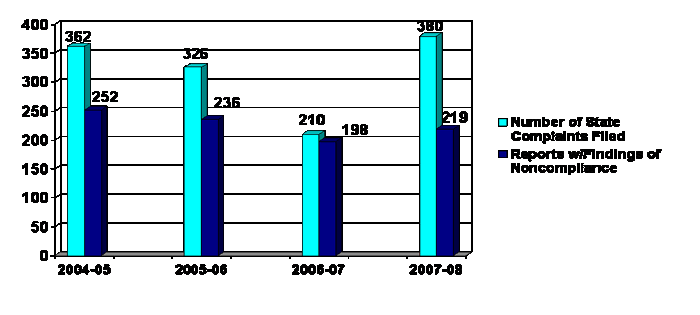
See http://www.vesid.nysed.gov/specialed/publications/policy/psgncover.htm
See http://www.nysdra.org/consumer/specialeducation.aspx.
See http://www.vesid.nysed.gov/specialed/publications/policy/mediationrequest.htm
See http://www.vesid.nysed.gov/specialed/publications/policy/coverdueprocess7105.htm
See http://www.law.buffalo.edu/IHO/
See http://www.vesid.nysed.gov/specialed/publications/policy/covercomplaint.htm