

Meeting of the Board of Regents | November 2008
|
|
|

 THE STATE EDUCATION DEPARTMENT / THE UNIVERSITY OF THE STATE OF NEW YORK / ALBANY, NY 12234
|
TO: |
EMSC Committee |
|
FROM: |
Johanna Duncan-Poitier |
|
SUBJECT: |
English Language Learners
|
|
DATE: |
November 12, 2008
|
|
STRATEGIC GOAL: |
Goal 1
|
|
AUTHORIZATION(S): |
|
SUMMARY
Issue for Discussion
The achievement gap for English Language Learners: what the current data and trends show. Does the Board of Regents want to revisit current policy and consider additional actions in light of performance data?
Reason(s) for Consideration
Review of Policy
Proposed Handling
The Regents EMSC Committee will discuss this report at the November 2008 meeting.
Procedural History
The Board of Regents asked that there be a more extensive policy discussion about where the greatest gaps in student achievement exist. In June, the Department released results of grade 3-8 tests, along with a review of trends in elementary and math achievement. In August, the Department released the most recent data and a review of trends concerning graduation. The three categories of students with the largest gaps in student achievement are: students with disabilities, Black and Latino males, and English Language Learners (ELLs). In September, the Regents discussed the graduation rate data for students with disabilities and for Black and Latino students with special emphasis on Black and Latino male students. This month, the Regents are discussing English Language Learners. In the next couple of months, experts and practitioners will join the Board of Regents to discuss achievement issues and strategies related to Black and Latino male students and English Language Learners to help inform future policies and actions that the Regents could take to help close the achievement gap for these students.
Background Information
More than 520 districts currently implement Bilingual and/or freestanding English as a Second Language (ESL) educational programs and services to over 250,000 English Language Learners in the state. These students represent over 170 different cultures and language backgrounds.
The ELL population is diverse in many ways including language, culture, level of English language proficiency, educational background/preparation, and grade and age when first enrolled in school. English Language Learners include: Students with Interrupted Formal Education, Long Term ELLs, Bilingual Special Education (BSE), New Immigrants, Gifted & Talented, and Former ELLs. Out of all the groups mentioned, Students with Interrupted Formal Education are at greatest risk of not meeting standards and not graduating from high school.
The education of English Language Learners has been and will continue to be supported by the firm commitment and policy direction of the Board of Regents. This commitment is articulated in the following five tenets that comprise the Regents policy and action plan for bilingual education in the State:
- All students in New York State shall become proficient in English, and to the extent possible, in another language, and all students shall understand and respect their own and other cultures.
- Educational access, equity and excellence shall be promoted for English Language Learners so that they become proficient in English and remain proficient in their native language.
- Programs for English Language Learners shall be staffed by qualified professionals.
- Parents and guardians of English Language Learners shall be actively encouraged to participate in their children’s education.
- The needs of English Language Learners shall be considered in the development of all State Education Department initiatives, and appropriate measures shall be taken to address these needs.
Graduation Rates and Overall Academic Performance
of English Language Learners
The performance of English Language Learners continues to be a pressing priority in the Regents and the Department’s education reform agenda.
In 2007, the federal government required that all students who have been in the country for more than one year must take the state’s regular English Language Arts (ELA) test, regardless of their English performance level. Consequently, ELLs who in 2007 had been enrolled for more than one year in a school in the U.S. (excluding Puerto Rico) were required to participate in the NYS English Language Arts Testing Program. The Board of Regents opposed this federal decision, since it does not allow English Language Learners adequate time to reach proficiency prior to testing. The Board has advocated strongly for its amendment.
English Language Learners have improved their performance on the grade 3-8 ELA tests. However, achievement remains low. The graph below illustrates the performance of ELLs on the 3-8 English Language Arts test. The results indicate that:
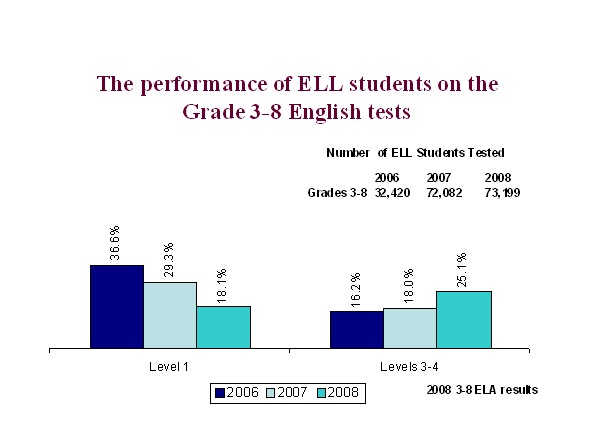 The percentage of ELLs achieving the learning standards (scoring at levels 3 and 4) increased from 16 percent in 2006 to 25 percent in 2008.
- The percentage of ELLs with serious academic difficulties (scoring at level 1) decreased from 36 to 18 percent.
The graduation rate for English Language Learners is very low. Only 25 percent graduated in 2007 after 4 years of high school. Forty-one percent were still enrolled, and 29 percent had dropped out. In addition, the percentage of English Language Learners graduating after four years declined by 5 percent, from 30.4 percent to 25.2 percent, between the 2001 and 2003 cohorts. The five-year graduation rate improves. For the 2001 cohort, 41.1 percent of ELLs graduated in five years, while 44.3 percent graduated in six years.
Former English Language Learners graduated at a much higher rate, higher than students who were never English Language Learners. Federal rules require us to define a former ELL student as one who has left ELL status within the last two years. Over 74 percent of former ELL students graduated four years after they entered 9th grade in 2003, compared to 71 percent of never-ELLs. (There were 4,009 former ELL students in the 2003 cohort; however, the New York City Department of Education shows about 19,000 former ELLs, defined as all students who were ever in ELL status at any point during their schooling.)
Among students who graduated, more English Language Learners earned a local than a Regents Diploma. More than a third of former ELL students also earned a local diploma.
Improvements in Certification of Bilingual and ESL Teachers
New York State has a shortage of certified teachers in several major fields, including special education, math and science, and bilingual education. However, the situation is improving. Among teachers of English to speakers of other languages (TESOL), in 2004-05, 13 percent of full-time equivalent teaching assignments were held by teachers without appropriate certification. In 2006-07, this was reduced to 8 percent.
Since 2005-06, there has been an increase in the number of teachers of English to speakers of other languages (TESOL). In that year, the Department issued 573 new certificates as compared to 677 in 2006-07 and 672 in 2007-08. However, a shortage exists in New York City, where there are 1.37 new teachers certified for every first year teacher taking a TESOL assignment in New York City public schools.
In bilingual education, in 2004-05, 46 percent of full-time equivalent teaching assignments were held by teachers without a bilingual education extension. In 2006-07, this improved to 28 percent. Similarly, in 2004-05, 22 percent of full-time equivalent teaching assignments in bilingual education were held by teachers without appropriate certification, compared to 19 percent in 2006-07.
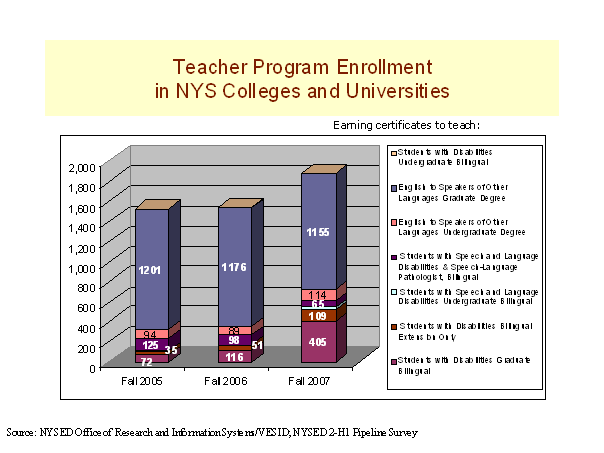 Finally, over the past three years, the Department has collected pipeline data of individuals in teacher preparation programs in critical shortage areas: special education, bilingual education, and teachers of English to speakers of other languages. We have seen a steady number of students enrolled in TESOL programs as well as in programs for students with disabilities with bilingual extensions.
Actions to Help English Language Learners
The education of English Language Learners has been and will continue to be supported by the firm commitment and policy direction of the Board of Regents. The Bilingual/ESL Committee of Practitioners, a broadly representative group of leaders with expertise in this critical field, provides important help and advice. (See Attachment C for a description and a list of members.)
The Regents and the Department have carried out a number of actions to help improve the education of English Language Learners. As the data above shows, these actions have not been sufficient to close the achievement gap that English Language Learners face, and the Regents may want to consider additional urgent actions. The actions taken so far have been informed by the education reform strategies included in the “Ten Action Steps for the Education of ELL Students” (See Attachment A). These actions include:
- Increased the requirement for English language instruction for English Language Learners commensurate with their grade and English language proficiency level.
- Improved initial identification and English language proficiency assessment requirements for ELLs to establish uniform and appropriate procedures throughout the State.
- Improved requirements to make school districts accountable for measuring and reporting the English language proficiency of ELLs annually.
- Improved procedures for the disaggregation and inclusion of English Language Learners in accountability determinations for English Language Arts and Mathematics, and for reporting their performance in these areas.
- Implemented a longitudinal data system to track the progress made by ELLs in English Language Arts and English Language Proficiency assessments.
- Approved testing accommodations for former ELLs for two additional years after scoring proficient on the NYS English as a Second Language Achievement Test (NYSESLAT).
- Established a Committee of Practitioners to advise the Commissioner and the Department on issues concerning the education of ELLs.
- Reviewed and approved Contracts for Excellence to try to ensure that the educational needs of English Language Learners are being met.
- Approved a number of programs and activities under the Bilingual Categorical Program, totaling $12.5m (See Attachment B)
- Revised the June 2009 Regents Examinations testing calendar taking into account the needs of English Language Learners.
The following actions are currently underway:
- Revision of the English Language Arts and English as a Second Language Standards.
- Monitoring selected school districts to determine whether they are providing appropriate services to English Language Learners.
- Increasing the number of appropriately certified bilingual teachers through the implementation of the Intensive Teacher Institute in Bilingual Education and the Intensive Teacher Institute in Bilingual Special Education.
- Development and dissemination of guidance documents which include information on: best practices for the education of ELLs; participation of ELLs in non-public and charter schools; programs and services for ELLs with disabilities; implementation of Reading First programs for ELLs; native language instruction, etc. (Full documents can be found at the following website: http://www.emsc.nysed.gov/biling/)
- Development of an Academic Language Framework for Living Environment, in collaboration with George Washington University- Center for Excellence and Equity in Education to assist ELLs in meeting the standards embedded in the Living Environment course and assessment.
- Improving teacher certification.
Critical Issues: Proposals from the Committee of Practitioners
English Language Learners continue to need additional help to achieve a quality education. The Committee of Practitioners, a valued advisory body on this issue, has brought forward a number of recommendations that are important to our policy discussion and actions. Some of these are local control issues. Others fall within State oversight; these issues include the need for an action plan to ensure that districts achieve increased annual targets for ELL graduation, improved fiscal accountability concerning district-provided services to English Language Learners, and increased monitoring of districts to ensure they provide needed services to English Language Learners. These are critical issues that we will address in the coming months.
Initiatives to Improve Leadership and Teacher Quality
The Regents have received a grant from the Wallace Foundation to transform school leadership in New York State. This will include the improvement of school leadership preparation programs and the provision of professional development through leadership academies. The focus will be to strengthen the role of the school leader as an instructional leader to reform teaching and learning. Specific emphasis will be given to those students who are most educationally at risk, including students with disabilities and English Language Learners.
In addition, the Department supports Intensive Teacher Training Institutes in shortage areas by providing tuition incentives to attract more candidates to these teacher shortage areas. These funds are directed at preparation programs in special education, TESOL, bilingual special education, and bilingual education extensions. This is an ongoing initiative, resulting in thousands of new teachers prepared in shortage areas since 1990. Also, there are statewide initiatives in related services such as speech language pathology and bilingual school psychology.
As the data indicate, a significant number of teachers with a bilingual education assignment do not possess a bilingual education extension. The Department is proposing a supplemental certificate to provide an expedited pathway for certified teachers to enroll in a bilingual education extension program and begin a bilingual education assignment.
Recommendation
Do the Regents want to consider additional policies and actions to improve the education of ELL students? Possibilities could include setting targets for increased ELL graduation rates. The Regents might also consider actions to increase access by ELL students to programs that incorporate best practices.
ATTACHMENT A
Twelve Action Steps to Assist English Language Learners in Meeting
the English Language Arts Standards
- Setting clear goals and providing curriculum using the ELA core curriculum as its base in both NLA and ESL classes to ensure that all ELLs successfully complete the Comprehensive Regents Examination in English.
- Providing intensive English language instruction to ELLs by increasing the daily instructional time requirement through revision of the Commissioner’s Regulations.
- Supporting and extended school day and year through after-school instruction, Saturday instruction, and/or summer English language academies.
- Initiating Project Jump Start through intensive English language instruction to newly enrolled students during the two weeks of August prior to the opening of school in September.
- Providing professional development through training sessions statewide on the ELA standards and assessments and how to teach English language arts to ELLs.
- Ensuring that certified teachers teach ELLs through the strengthening of teacher preparation programs and by helping uncertified bilingual and ESL teachers become certified.
- Communicating effectively with parents through the implementation of a two-hour orientation on the standards within the first semester of the enrollment of their child(ren) in a New York State school.
- Ensuring equity in technology and instructional resources by providing equal access to computers, instructional technology, and materials that support native language and English language literacy development.
- Improving identification and assessment by ensuring that English language achievement will be measured uniformly throughout New York State.
- Requiring specifications for improving local accountability by requiring that districts implement the Regents recommendations to assist ELLs in meeting the ELA standards.
- Supporting the development of model programs by identifying those programs which incorporate the Essential Elements of Effective Programs for ELLs, and by disseminating information about them.
- Improving reporting and collection of ELLs achievement data by working with the State Education Department, school districts, and BOCES.
ATTACHMENT B
Summary Overview of Grants and Contracts
Bilingual Education Technical Assistance Centers (BETACs):
Fourteen (14) Bilingual Education Technical Assistance Centers provide technical assistance to school districts, especially those where ELLs fail to meet State standards, to build and/or strengthen their capacity to serve ELLs through CR Part 154 and NCLB Title III programs.
Two Way Bilingual Education Program:
The Two-Way Bilingual Education Program is designed to promote academic excellence in core subjects and to develop proficiency in two languages (one of which is English) in the English proficient and ELL students. Eight grants were awarded to NYC CSD 6, CSD 9, and CSD 29 and Syracuse CSD, New Rochelle CSD, Long Beach CSD, UFSD of the Tarrytown and Yonkers CSD.
Intensive Teacher Institute (ITI) for Bilingual and ESL Teachers:
The ITI is designed to increase the pool of certified bilingual and ESL teachers in New York by helping bilingual and ESL provisional preparatory teachers (PPT) meet the course requirements for certification in approved institutions of higher education (IHE).
Bilingual/ESL Teacher Leadership Academy (BETLA):
The BETLA initiative is consistent with the Regents goals to develop educational leadership and with their 12 Action Steps to support professional development activities for teachers of ELLs. This initiative is also consistent with the No Child Left Behind, Title III requirements to provide high quality on-going professional development. The program was created to instill leadership skills in exemplary teachers who then work to support fellow teachers working with ELLs. BETLA supports bilingual and ESL teachers from Community School Districts in New York City. Phase I of the program provides leadership training to carefully selected teachers in an intensive summer academy. Model demonstration/LABS classrooms for excellence in teaching and learning are established in Phase II. Phase II also continues the teacher leadership training.
Hispanic Youth Leadership Institute (HYLI):
HYLI is designed to promote and develop leadership and public speaking skills and an understanding of the New York State Legislative process and parliamentary procedures. Participation is limited to 200 Latino (junior and senior) high school students studying New York State Law and Government. Prior to a three-day institute, students receive training on the legislative process and select legislative initiatives to research and debate. At the institute, students meet with legislators and debate actual legislative bills in a mock assembly session.
Supplemental Middle School/High School ELL Grant:
The High School ELL Grant initiative will focus on the development of before and/or after school tutorial programs or Saturday tutorial programs to help ELLs meet the New York State standards and graduation requirements. Instruction may be provided in English, English as a second language, or in the ELL student’s native language.
ELL – Program Evaluation Toolkit (PET):
SED is also working on an ELL Program Evaluation Toolkit, a comprehensive self-evaluation tool that includes guidelines and rubrics, for individual districts/schools to review State and federal regulations regarding students for whom English is not their native or home language and to determine the nature and extent of services required for ELLs. The goal is to have all districts and schools with ELLs use this tool within the next five years for self-evaluation purposes.
Funding Summary for 2008 - 2009
|
Programs |
Total Funds Allocated |
|
BETAC’s |
7,224,090.00 |
|
Two-Way Bil. Ed Programs -I |
1,929,000.00 |
|
ITI - Teacher Certification Program |
945,859.00 |
|
BETLA |
789,388.00 |
|
HYLI |
288,629.00 |
|
High School ELL Grant - 1 |
698,241.00 |
|
High School ELL Grant - 2 |
324,793.00 |
|
Bil/ESL PET (Program Evaluation Toolkit) |
300,000.00 |
|
Total |
12,500,000 |
Bilingual / ESL Committee of Practitioners Membership List
Attachment C
�
The Bilingual/ESL Committee of Practitioners is a broadly representative group of education leaders with expertise in this critical field. This group provides valuable advice and information to the Regents and the Department on critical issues affecting English Language Learners. The Committee of Practitioners meets three times a year.
|
Name
|
Title |
District/Organization |
|
|---|---|---|---|
|
Gregory Andronica |
ESL Teacher/ Coordinator
|
High School of Arts |
|
|
Deycy Avitia |
|
NY Immigration Coalition
|
|
|
Dr. Abul Azad |
Teacher
|
NYC Department of Education |
|
|
Joanne Beard |
Past-President
|
NYS TESOL |
|
|
Jennifer Bell-Ellwanger |
Senior Instructional Manager |
NYC Department of Education
|
|
|
Eudes Budhai |
Director of Bilingual/ESL/Dual Language & Adult Basic Education
|
Westbury UFSD
|
|
|
Rose Colon-Cisneros |
Supervisor Bilingual/ESL |
Office of Multilingual Education
|
|
|
Nicolle L.Crocker
|
Program Evaluator Bilingual/ESOL
|
Rochester City School District
|
|
|
Dr. Gladys Cruz |
Director of Staff Development |
Questar III, BOCES
|
|
|
Jose Davila
|
Director of Education Advocacy/State Government Affairs Representative
|
NY Immigration Coalition
|
|
|
Dr. Candido De Jesus |
Director for the BETLA Bilingual/ESL Teacher Leadership Academy
|
Bank Street College of Education
|
|
|
Elieser De Jesus |
Director Bilingual Pupil Services |
NYC Department of Education
|
|
|
Daria De Piro |
Assistant Principal
|
NYC Department of Education |
|
|
Carmen Dinos
|
Consultant |
Academic Enterprises, Inc. |
|
|
Gladcia Drew
|
A.P. Supervision Second Language Department |
Samuel J. Tilden High School
|
|
|
Milagros Escalera
|
Principal |
Porter Magnet School
|
|
|
Catalina Fortino |
ELL Program Coordinator |
UFT Teacher Center |
|
|
Larry Hirsch |
Director |
New York Comprehensive Center
|
|
|
Joshua Kamensky |
Deputy Superintendent |
Kiryas Joel School District
|
|
|
Carmen Kasper |
Director of Bilingual / ESL |
Huntington UFSD
|
|
|
Estee Lopez |
Director, Bilingual/ESL |
City Schools of New Rochelle
|
|
|
Olga Maluf |
|
UFT Teacher Center
|
|
|
Dr. Jim Mapes |
District Superintendent
|
Nassau BOCES
|
|
|
Dr. Cindy McPhail |
Chair, Department of Language, Literacy and Technology Director, Graduate TESOL Certification Programs and Bilingual Extension Program
|
Nazareth College
|
|
|
Carlo Mitton |
Consultant
|
|
|
|
Nancy Narvaez-Smrkolj |
Teacher |
Dodson Elementary Yonkers Public Schools
|
|
|
Maria Neira
|
Vice President |
New York State United Teachers
|
|
|
Dr. Aida Nevarez-LaTorre |
Professor |
Graduate School of Education Fordham University
|
|
|
Lourdes Odell
|
Executive Director Bilingual/ESL Programs
|
Rochester CSD
|
|
|
Fran Olmos |
1st Vice President TESOL
|
Yonkers Public Schools
|
|
|
Dr. Samuel Ortiz |
Associate Professor Department of Psychology
|
St. John’s University
|
|
|
Angela Pagano |
Director, Title I/ESL |
Yonkers Public Schools
|
|
|
Marie Perkins |
Principal |
Seymour Dual Language Academy
|
|
|
Joel Petlin |
Superintendent of Schools |
Kiryas Joel School District
|
|
|
Tamara Pozantides
|
Director of Multilingual Education |
Office of Multilingual Education
|
|
|
Yvonne Pratt-Johnson |
Professor of TESOL
|
St. John’s University |
|
|
Bryan Pu-Folkes
|
Executive Director |
New Immigrant Community Empowerment
|
|
|
Mary Ellen Quinn
|
Research & Educational Services |
New York State United Teachers
|
|
|
Cornelia Randolph
|
President |
NYS TESOL |
|
|
Dr. Luis O. Reyes |
CEEELL Coordinator |
Lehman College
|
|
|
Tiara Reyes-Vega
|
Assistant Principal |
Robert C. Dodson School
|
|
|
Jounghye Rhi |
Teacher |
NYC BOE Newton High School
|
|
|
Dr. Eva Roca |
Director of TESOL/Bilingual Education Programs Adelphi University School of Education
|
Ruth S. Ammon School of Education
|
|
|
Carmen Rodriguez
|
|
|
|
|
Raymond Sanchez |
Deputy Superintendent
|
Ossining Union Free School District |
|
|
Maria Santos |
Director, OELL |
NYC Department of Education
|
|
|
Elizabeth Sheffer |
Assistant in Educational Services |
NYSUT
|
|
|
Dr. Kim Hynag Soon |
Assistant Professor M.S. Ed. in TESOL
|
D'Youville College
|
|
|
Laticha Sotero |
Executive Operations Director and Instructional Technology Specialist |
New York Comprehensive Center
|
|
|
Judith Stern Torres |
Consultant
|
|
|
|
George Talley |
Board Member BOE |
Brentwood SD
|
|
|
Carmen Vazqueztell |
Director of Bilingual Education and ESL |
Temple Hill Academy Newburgh Enlarged CSD
|
|
|
Nancy Villarreal De Adler |
NYSABE Ex. Director |
New York State Association For Bilingual Education (NYSABE)
|
|
|
Marina Vinitskaya |
Region 6 ELL – RIS, Compliance |
NYC Department of Education Region Six RIC
|
|
|
Larry Waite |
Manager of Educational Services |
New York State United Teachers
|
|
|
Ron Woo |
Director of Teaching Fellows Program
|
Hunter College
|
|
|
Tony Zhen Wu |
Assistant Principal
|
PS 105-Region 7, NYC |
|